Creating Outdoor Connections
June 2026by Rachel White
At the start of a project, homeowners often complain that they feel cut off from their outdoor spaces. There are too few windows. Views are unappealing. Side and back doors are inconveniently located. Whatever outdoor sitting or dining area does exist feels like an afterthought and is rarely used. These complaints are worth addressing as part of a home renovation even if they aren’t at the top of the priority list. Appealing views to the outdoors make interior spaces feel and work better, while thoughtfully located doors create easy and intuitive access.
Of course, the goal isn’t just more appealing views and better access. You also want outdoor spaces that are as functional and enjoyable to spend time in as interior ones. A deck, porch or patio designed with the same care and attention as the interior rooms it adjoins becomes someplace you actually want to be. Outdoor spaces also offer something that interior rooms can’t: the ability to immerse yourself in nature. To feel the breeze on your skin. To hear the hum of bees or birdsong. To smell the scent of lilacs. To watch the clouds drift across a blue sky.
The Home in Relation to the Site
Every successful indoor-outdoor connection begins with understanding the home in relation to the site. The shape of the lot and where the home is situated on it, the grade, tree cover, areas of sun and shade, and proximity to neighboring structures (which often reveal where privacy can be more easily achieved) determine what’s possible.
From there, we need to understand what homeowners want from their outdoor spaces. Are there views they especially love? Do they want to garden? Do they hope to entertain outdoors? Do they need play space for their kids? The answers inform both the interior and exterior plans - which rooms face where, where openings make sense, and how we program the outdoor spaces.
Bringing the Outdoors In
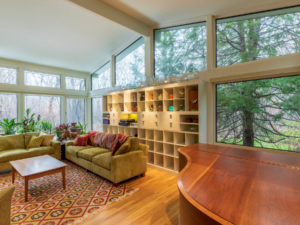
Washing dishes looking out at your garden is far more pleasurable than washing dishes while looking at your neighbors’ trash cans. It’s easier to start your work day if your home office is flooded with morning light than if it’s dark and drab. These aren’t trivial features. Natural light, views and sightlines shape your experience in interior spaces.
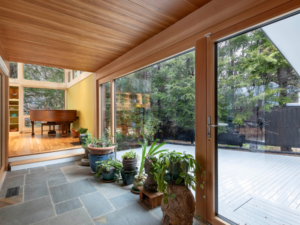
But connection to the outdoors isn’t just about what you experience from the inside. Successful outdoor connections invite you outside at the same time as they bring the outdoors in. For example, replacing a single, solid door to a back deck with a double glass door in a widened opening beckons you onto the deck, eases circulation between indoors and out, and opens views not just to the deck but to the garden and yard beyond.
Outdoor Living Spaces
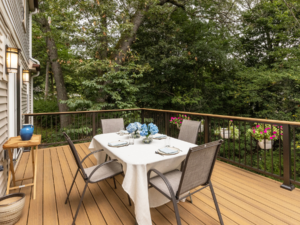
The key to creating successful outdoor living spaces is to bring the same care and thought to their design as to interior spaces. When we design a dining room, we ask how many people the table needs to accommodate. We need to ask the same question of outdoor dining spaces. Is it primarily for everyday, family meals? Or does the outdoor dining space need to accommodate dinner parties?
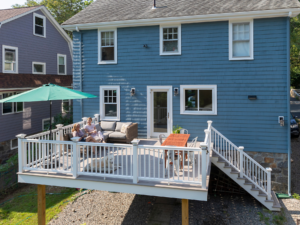
It also helps to understand how homeowners actually live. Are they people who would be unlikely to cover their outdoor furniture? If so,maybe a covered porch is a better choice than a deck. Are they sun mavens? If so, maybe a deck is a better choice than a porch. And anyone who has tried to eat dinner outside on a summer evening in New England knows that mosquitos can make it miserable. Homeowners who want to use their outdoor spaces after dark might be better served by a screened porch than a deck.
If the homeowner is a gardener, we need to design with access to tool and material storage in mind and think about how they will enter and exit while in gardening mode. We don’t want them to walk through living spaces covered in dirt to get to a place where they can wash up. I know this first hand: the back door to my mudroom is inconveniently located, which means that the path of least resistance is always through the kitchen and screened porch – exactly the route I don’t want to take after spending the morning pruning or pulling weeds.
When outdoor spaces are designed with intention, they stop being features that look good only on paper and start meeting real needs, which is the key to becoming spaces where people actually spend time.
Outdoors at Home
Integrating a home with its surroundings requires that every decision attends to the home’s relation to its site – from how primary living spaces are oriented, to the size and location of windows and doors, to the choice of a deck, porch and/or patio. When that attention is consistent, the result is a home alive in its surroundings and one where you can live fully both indoors and out.
Before you embark on a renovation, ask yourself: what does my site offer and how can I take advantage of it? The answer may reveal opportunities that you would miss if you were focused only on your goals for interior spaces. A kitchen with views and easy access to a garden, a screened porch where you can sit outside on a hot August evening, a patio within a few steps of a swing set – these aren’t ancillary extras. They are integral to how your home feels and works day to day. Rooms seem larger. Light is more present. Spending time outdoors becomes a natural part of everyday life.
If this is something you’d like to explore for your home, we’d love to talk.